Today I've got another guest post over at KG's blog, Write Now Is Good, and it's about basic GTD (Getting Things Done),the best productivity system that I've ever used, and how creative folks can use it to capture ideas.
As I was reading back over the post on her blog, I was reminded about an incident from a few weeks ago when I was exchanging emails with a reader. He was telling me that as a creative person, for him, organization is an emotional choice and that the visual design of the tools he uses plays a big part in his system.
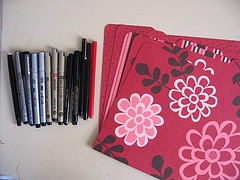
He said he likes to visually engage himself with little details like multi-colored post-it notes, folders and paper, elegant sketch books and fancy pens. He also uses bold signs and screen savers with project names to sort of hit himself in the face with what he needs to do.
The Art of Productive Procrastination
I had written him back basically saying that as a creative person
myself, I know that I'll always be drawn to what's visually appealing, but I don't kid myself that the visual look of my tools has anything to do with productivity.
I know what it feels like to "need" to have the pastel shades of hanging file folders rather than the plain manilla ones and to be drawn to the cute red leather dayplanner as opposed to the plain plastic black one. I also have a tendency to "accidentally" spend an hour or so looking for the perfect pen at the office supply store, and by "perfect", I mean that the physical design of the pen is as appealing as the functionality.
One thing I told him was that, although we creative folks might have a tendency to be distracted or drawn to the pretty, shiny stuff, that it is important to realize that the visual look of our productivity tools is just icing on the cake--it's not substantial enough to have a long lasting impact on our overall productivity.
In fact, focussing on the visual look of our tools can actually be a form of "productive procrastination" :-).
When we decide that we'll increase our productivity by tracking a project in an elaborate, colorful chart, most of us will probably end up devoting an over-abundance of energy to crafting the beautiful chart rather than focussing on the actual project the chart is supposed to be tracking.:-)
Simplicity Rules: A basic notebook will do the job
One thing I focus on is the "streamlining" of collection tools for
ideas/information so that everything is captured and there's no "Oh,
no--where did I put that?" or "I know I was supposed to do something
today, but I can't remember what!" feeling.
Instead of relying on colorful post it notes and sketch books/charts, I like to keep things incredibly simple. I use a simple notebook with separate sections in which to keep my lists, and my ideas are categorized onto these lists. The list topics are:
*A calendar--to house my to-do items that have a specific date and time
* Next Actions--basically a to-do list without specific dates and times
* Someday/Maybe--stuff I'd like to do someday eventually
* Waiting For--things that need input from other people before I proceed
* On-the-go--a little spiral bound memo book that I keep in
my purse. If I'm out and about and I get an idea or it pops in my mind
that there's something I need to do, right away I right it down on the
on-the-go list I keep with me. When I get home, I can transfer the item
to the appropriate list.
A Pen Is Just A Pen
The bottom line is no matter how eye-catching the container for
the information is, there's still nothing that will make us actually do
the stuff on our lists unless we want to.
If you get that fancy pen or the really cool electronic organizer, you may be excited about using
those tools for the first few days, but eventually the thrill will wear
off, and you'll be back to square one, having to face the fact that your system
isn't doing what you need it to do.
If we have a fail safe system for capturing info though, then we don't really need to motivate ourselves to write stuff down by having fancy dayplanners and pens. All we need to do is rely on the system we've put in place to manage our information.
So, if it amuses you to get the fancy pen and elegant paper, that's fine--go for it, but don't kid yourself that the prettiness of your organizational tools is going to make you more productive. In fact, if you really feel like you need a fancy pen and elegant paper in order to get organized, you might want to re-think the stability of your system.
The truth is, if you've got a strong, reliable system, it really doesn't matter what kind of pen you use.




Comments