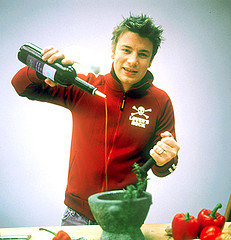
Last night I got pulled into watching a reality cooking show--I think it was called "Jamie's Kitchen".
The star of the show was Jamie Oliver --you know, the Naked Chef (BTW--did you know he has a podcast? Never would have guessed!), and he was training a bunch of restaurant newbies how to be professional chefs and function as part of a team in a busy kitchen.
Talk about an organizational nightmare!
Jamie needed to get 15 untrained strangers to work as a team and produce:
- High quality food (if it's not perfect, then you have to start over from scratch)
- Quickly (take too long and the customers will get fed up and leave),
- Consistently (the presentation should be exactly the same each time the dish is made),
- And in a synchronized manner (all meals at each table should go out at the same time).
So, how did Jamie bring order to the chaos?
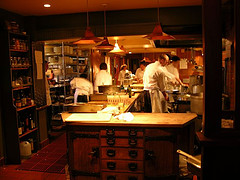
Genius--He assigned each chef to a station and had them each make just one thing.
There was the salad station, the entree station, the dessert station and an appetizer station. When an order came in, the folks at the various stations listened for their part of the order, and then got to work producing the dish that was requested-- "One caesar salad, hold the croutons!" etc.
Imagine what that kitchen would be like if Jamie wasn't there making the frontline executive decisions about who handles each part of the order and the priority for each one.
It would be utter chaos and impossible to produce quality work quickly, consistently, in a synchronized manner.
I think most of us can relate to that kind of disorganized workflow at some time or another.
You're working on a project, then you hear your email chime, so you go look to see what "orders" just came in. Then you remember that you promised to make dinner that night, and you hadn't been to the grocery yet (there's another order).
Then you realize that you've got to figure out what to cook (another order). Then a phone call comes in, and it's a client asking you to take care of something for her (yet another order).
Oh, and your mother's birthday is in a couple weeks and you want to do something special (another order). Then the doorbell rings and it's your neighbor asking you if you'll feed her cat when she's out of town (another order!).
Everywhere you turn, more orders are pouring in!
Pretty soon you're not really getting anything done anymore--you're just sort of sitting there stacking up the orders.
It starts to feel like that's kinda what your job is: "I've gotta take the orders, check the email, check the voicemail, take more orders."
And then you start to think, "Hey--If I'm busy taking the orders all the time, when will I have time to fill the orders?"
What each of us needs is someone like Jamie to annouce the orders at the right time, tell us the priority, and have us work on only one thing at one time.
Oh, that would be lovely!
"Where can I get one of these executive decision makers to make my life easier?", you ask.
Well, In case you haven't guessed, the executive decision maker in each of our lives needs to be US.
We each need to play the role of Jamie in our own lives.
This means controlling when the orders come in so that we aren't constantly in order-taking mode. You can do this by turning the "You've got mail" chime off on your email, or by having scheduled email checking times. You can also do it by reducing noice, interruptions, and letting the phone go to voicemail instead of always picking up (if this is feasible with your work).
This means having an order taking process so that, no matter how urgent or non-urgent the order is, it doesn't fall through the cracks. I call this process "stop storing info in your brain". This is a GTD principle, and if you'd like to learn how and why you shouldn't store info in your brain, check you my post here.
It also means prioritizing the orders that come in--remember the newest information we receive is not necessarily the most important!
David Allen says that one of the biggest challenges he sees people face as they struggle to manage their workflow is that they aren't making effective, quick frontline executive decisions. Rather, they're procrastinating, pushing info to the side, and storing info (you know that overflowing inbox!)instead of making decisions on the front end and acting on those decisions.
Once the orders that are truly important get are moved to the front of the list, we need to tackle each one in the right order and focus on one thing at a time.
You know how folks are always talking about "multi-tasking", about being able to do 2, 3, 4, 5 or more things all at once?
I used to aim for that kind of mental dexterity, but the more I study GTD, the more I think that "multi-tasking" is just a glorified way of saying, "I'm incredibly disorganized and not focusing completely on anything at all."
Multi-tasking is a fairy tale.
Really, we have one brain, two hands, two eyes and ears--technically speaking we can really only do one thing at a time.
The sooner we relieve ourselves of the expectation that we should be able to do a million things at once, the more we'll be able to accomplish and the less stress we'll feel.
By learning to make executive decisions on the front end and focusing on doing one thing at a time, no matter how hectic or chaotic our workday becomes, we'll still be able to produce quality work quickly, consistently, in a synchronized manner, just like Jamie's team of chefs in his restaurant kitchen.






Recent Comments